
Riding the Waves: From Steam Engines to AI
- scyhl13
- Nov 21, 2023
- 6 min read
In the turbulent aftermath of the Russian Revolution, Nikolai Kondratieff unveiled an economic theory so provocative it sealed his fate. Kondratieff proposed the existence of long waves in capitalist economies — a cycle of economic ups and downs contradicting the prevailing Soviet dogma of inevitable capitalist doom. His insights not only challenged the orthodoxy of his time but also cost him his life, making him a martyr to the empirical study of economic cycles. Nearly a century has passed since, with the recent global economic slowdown and the unprecedented innovations stemming from Artificial Intelligence (AI), the Kondratieff wave seems to offer a precinct lens through which to interpret these contemporary phenomena.
Background
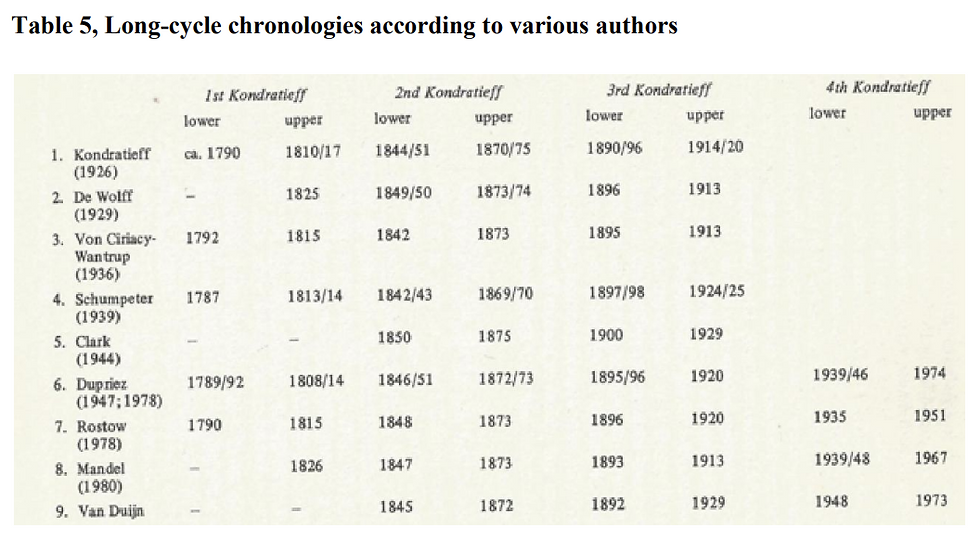
Nikolai Kondratieff, a prominent Soviet economist, made a discovery in the 1920s. He identified long-term economic cycles in capitalist countries, notably England, France and the United States. Through tracking and analysing indicators like prices of agricultural products and copper, he revealed long-term cycles lasting approximately 50 to 60 years in capitalist countries, characterised by phases of prosperity, recession, and depression (Akhilesh Ganti, 2021). These observations, coupled with his role at the Institute of Conjuncture in Moscow, led to his formulation of the Kondratieff Waves.
What is the Kondratieff Wave?
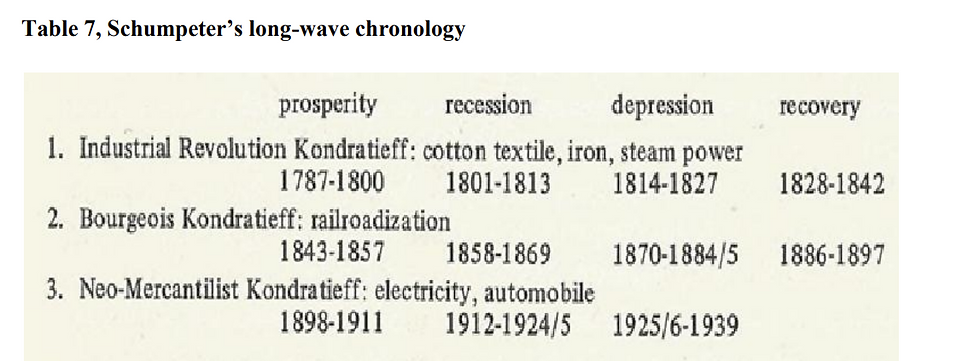
Long-wave theory (later dubbed as Kondratieff waves) states that development in capitalist economies occurs generally within long-term cycles spanning an average of 50 years. According to Kondraiteff and Schumpeter, these cycles are usually due to a particular technological advancement or innovation in an era. Proponents of the theory – starting with Schumpeter – suggest that these innovations lead to phases of the long-term prosperity of the overall economy (Metz, 2010).
A Kondratieff Wave consists of 4 main phases akin to seasons, i.e. spring, summer, autumn, and winter. Spring, or the early phase of the wave, is characterised by substantial growth due to innovations and, thus, increases an economy’s output. This growth continues in summer and reaches its maximum within the cycle at a slower rate with a reduced pace in innovation as more and more firms imitate the success of firstcomers. Autumn is the beginning of the downturn, with the market getting increasingly saturated, and results in declining profitability and reduction in output levels, creating conditions for a recession. Finally, winter is considered the height of the downturn in the cycle, with saturation in the market reduced and conditions ideal for the following spring.
The First Wave
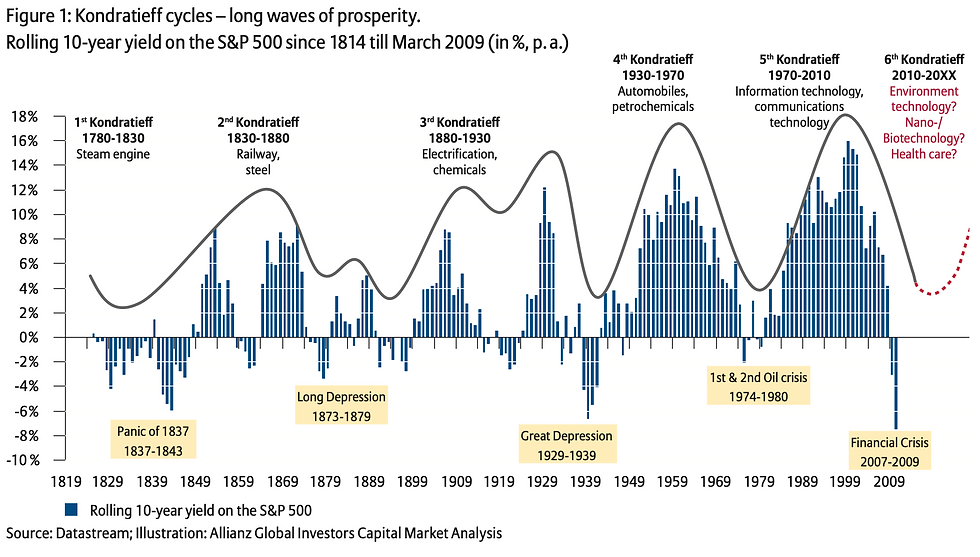
The first wave is believed to have lasted from 1780 to 1830, which coincided with the start of the Industrial Revolution: the movement from agricultural production to a factory-based economy that was mainly prominent in the UK and France. The development of steam engines in the Industrial Revolution helped advance the economy by providing jobs in the textile industry (Narkus, 2012). The first long wave's fall was exacerbated by climate change, which led to low food production and famine in industrialised capitalist countries. The economy was no longer growing due to the development of the steam engine but rather experienced a recession that persisted until the second wave, which was impacted by the expansion of the steel sector.
The Second Wave
The second long-term wave -initiated due to the practical implementations of locomotives and subsequent improvements in transportation, is considered to have lasted from 1830 to 1880 (Kondratieff Wave, n.d.). During this time, the European economies and the United States invested heavily in building large railway lines, leading to more efficient movement of people and cargo (Narkus, 2012). These railway lines helped develop urban centres and resulted in job creation in metallurgy. Additionally, further innovations during this time, such as the Bessemer process, helped reduce the cost of steel manufacturing, further increasing profits. According to Kondraiteff, the decline of this cycle was reached in 1873, following greater protectionism between countries and would continue until the third wave.
The Third Wave
The third wave, initiated by electricity discovered in the second wave, started in 1880. The discovery of electricity led to increased use of conveyor belts in factories. Conveyors significantly increased manufacturing capabilities, reduced financial resources needed, and increased manufacturing effectiveness levels (Narkus, 2012). The third wave is often characterised by the practical application of science, the production of automobiles and other inventions which were inspired by scientific knowledge. World War II caused prices of all goods, specifically food, to rise as the food was rationed, leading to a fear of famine in countries such as the UK. The third wave was thought to have ended after World War II because the newly developed technologies were no longer novel and too costly.
The Fourth Wave
This wave is believed to have begun around the time of the Second World War and continued up to the 1970s and was primarily driven by automobile manufacturing and demand for petrochemicals. Following the war, the US-led global trade by providing loans and exporting its industrial output globally, with European economies following suit. The rise in the global demand for automobiles, along with greater overall consumer demand, created conditions for greater demand for petrochemicals. The end of this cycle was driven by the oil crisis, created due to OPEC increasing oil prices and elevated inflation in industrial economies.
The Fifth Wave
The fifth long wave was believed to have lasted from 1970-2010, when the "industrial society began transitioning to an information society" (CFI Team, n.d.). The invention and development of computers led to an increase in productivity in many sectors of their economies. In addition, as computers were employed for military, scientific, and public affairs, as well as far more useful uses in daily life, they became the economic driving force for the fifth long wave. The fifth wave ended by the time of the global financial crisis in 2008, when assets dropped sharply in value, businesses and consumers struggled to pay their debts, and liquidity dried up (Kenton, 2023).
Are we anticipating a new wave?
As the beginning of the last 5 waves coincided with the emergence of technological innovations, which served as key economic drivers, could the recent development in AI technologies signify entrance into the 6th wave?
The development of AI, particularly with the launch of OpenAI’s ChatGPT nearly a year ago, has highlighted the profound capabilities of this technology. ChatGPT, powered by a large language model trained on a massive corpus of internet data, can generate not only human-like text, but also possesses a far broader impact.
Bullist advocates think ChatGPT and its counterparts of generative AI will fundamentally transform work, communication, the creative arts, and practically every other discipline. The potential economic impact is staggering, with generative AI projected to add up to $4.4 trillion in value to the global economy annually through productivity enhancement. This technological leap made by AI echoes Elon Musk’s description, “the most disruptive force in history,” highlighting its profound transformative potential for the industry and many others.
Conclusion
In light of the insights from Nikolai Kondratieff and Joseph Schumpeter and the recent advancements in AI technology, we stand at a significant crossroads in economic history. The concept of Kondratieff Waves, enriched by Schumpeter's theory of "creative destruction," provides a robust framework for understanding the cyclical nature of economic growth and decline driven by technological innovation.
This juncture, possibly the onset of the sixth wave, underscores a transformative shift fueled by AI, exemplified by breakthroughs like OpenAI's ChatGPT. The anticipated impact of AI on the global economy, with projections of adding trillions in value, mirrors the disruptive patterns observed in previous waves.
Yet, as history teaches us, each wave of innovation brings its cycle of economic realignment. The rise of AI, while opening doors to unprecedented advancements, also signals a potential phase of adjustment where traditional industries and job structures may undergo significant transformation. The challenge lies in balancing the embrace of innovation with preparedness for the ripple effects it brings across economies and societies.
As we navigate this potential sixth wave, it is important to apply the lessons from the past Kondratieff Waves. This means not only leveraging the opportunities presented by AI but also being vigilant about the economic and societal shifts it heralds. In essence, the Kondratieff Waves theory, enriched by modern technological insights, offers a compelling framework for understanding and navigating the complexities of our evolving economic landscape.
Authors: Lau Hui Geng, Abdul Mugeeth, and Nur Farhana Khairul Azhar.
Sources and additional readings:
Grinin, L., Korotayev, A. and Tausch, A., (2008). Kondratieff waves in the world system perspective. In Kondratieff waves, warfare and world security (pp. 23-64). Amsterdam: IOS Press.
Kondratieff Wave (no date) Corporate Finance Institute. Available at: https://corporatefinanceinstitute.com/resources/economics/kondratieff-wave/ (Accessed: 5 November 2023).https://corporatefinanceinstitute.com/resources/economics/kondratieff-wave/
Narkus, S. (2012) ‘Kondratieff, N. and Schumpeter, Joseph A. Long-waves Theory’, Analysis of Long-cycles Theory [Preprint].30907274.pdf (core.ac.uk)



Comments