
Tragedy of the Commons
- sayyt16
- Dec 24, 2023
- 9 min read
1.0 Introduction
The tragedy of the commons is a compelling concept that delves into the complexities of resource management and societal behaviour within shared spaces. The concept was first capitalised on by a British writer, William Forster Lloyd, in 1833 (Alexandra, 2019). It then traces back to an influential essay penned by ecologist Garrett Hardin in 1968, where he eloquently depicted a conundrum inherent in the utilization of common resources within communities (Matto, 2019). Hardin's concept emerged during a period of burgeoning environmental awareness and concerns about the sustainability of shared resources. The term "commons" refers to resources accessible to all members of a community without individual ownership or regulation. These could encompass grazing lands, fisheries, clean air, water bodies, or any shared resource where individuals can freely partake without restriction.
1.1 Background of The Tragedy of the Commons
The core premise of the tragedy of the commons revolves around the inevitable clash between individual self-interest and the collective well-being of a community. Hardin highlighted a scenario where rational individuals, driven by their self-interest, exploit a common resource without considering the long-term repercussions for the entire group. He articulated this dilemma through a narrative (Figure 1): Picture a shared pasture accessible to all local herdsmen. Each herdsman seeks to maximize personal gain by grazing as many cattle as possible on this pasture. However, as more cattle are added, the pasture becomes overgrazed, ultimately leading to its depletion (Media Inc, 2016). The tragedy unfolds as the pursuit of individual benefit inexorably harms the collective good, leaving a barren and unusable resource for everyone. Hardin's concept resonated deeply within environmental and economic circles, sparking debates about resource management, sustainable practices, and the role of regulation or communal responsibility. It served as a foundational idea in understanding the challenges of governing and conserving shared resources in the face of individual incentives that often conflict with the broader interests of society.

Figure 1: The Cattle’s Concept of The Tragedy of the Commons
(Source: OWEN, 2021)
2.0 explanation and analysis
The Tragedy of the Commons stands as a profound paradigm revealing the dynamics of shared public resources. It underscores the consequences of individual self-interest on the collective well-being, portraying a scenario where the exploitation of shared resources leads to the detriment of the entire community. Shared resources, often termed public resources, constitute a diverse array encompassing physical, natural, or abstract assets, accessible to multiple individuals or groups. The significance of these resources lies in their shared nature, where the utilisation by one party can significantly impact the availability and quality of access for others. The interconnectedness of resources, such as air, water, and land, establishes a delicate balance where actions on one front reverberate across the entire community.
Four fundamental factors contribute to the emergence of the Tragedy of the Commons: competition, non-exclusivity, scarcity, and the nature of public resources (THE INVESTOPEDIA TEAM, 2023). Delving into these factors reveals the complexities underlying the phenomenon. Competitiveness, denoting a resource usable by only one person, fosters an environment where all individuals become competitors for its benefits. Non-exclusivity, highlighting the inability of a single person to prevent others from utilising a resource, accentuates the shared and open-access nature of these assets. Scarcity, a critical component, suggests that the competitive resource must be limited in supply, as a non-scarce resource lacks the inherent competition necessary for the tragedy to unfold. Public pool resources, being both shared and scarce, represent a unique blend of public and private goods, further complicating their management.
Historically, the Tragedy of the Commons has persisted across various contexts, illustrating the pressing need for multifaceted solutions. Three main avenues stand out in addressing this predicament: regulation, cooperation, and awareness. Governments play a pivotal role in managing public resource use through effective regulation. Implementing new regulations or refining existing governance structures becomes imperative (Bansard and Schröder, 2021). This includes setting quotas, imposing usage restrictions, and rigorously enforcing rules to prevent overuse and exploitation. The establishment of partnerships forms another critical dimension in mitigating the tragedy. Encouraging cooperation among relevant groups fosters collective responsibility. This cooperation extends beyond individual communities and may involve collaboration between different groups or even countries. Transnational, cross-corporate, and cross-class resource allocation initiatives exemplify the potential impact of cooperative efforts. Long-term solutions necessitate a heightened awareness of the consequences of resource misuse (Mathew, Sivaraman and Chandy, 2019). Public awareness campaigns are paramount in shaping a collective consciousness toward sustainable practices. Through education, publicity, and social initiatives, the public can be informed about the importance of responsible resource allocation. Raising awareness not only addresses the immediate concerns but also lays the groundwork for sustained improvements, ensuring the stability of results over time. In conclusion, the Tragedy of the Commons serves as a poignant reminder of the delicate balance required in managing shared public resources. Recognising the intricate interplay of factors and addressing them through regulation, cooperation, and awareness offers a pathway towards sustainable and equitable resource use. Through collective effort and informed decision-making, societies can navigate the challenges posed by the tragedy, safeguarding shared resources for present and future generations.
3.0 Real-world examples
According to the American ecologist Garett Hardin (1968), who coined the term, one of the most prominent examples of the tragedy of the commons is environmental pollution (Hardin, 1968). In his essay, he argues that the masses are locked into a system of "fouling our own nest," so long as they behave only as independent, rational, free enterprisers who continue to pollute the environment. A strong believer in Thomas Robert Malthus’s Malthusian Theory himself, he argues that the natural chemical and biological recycling mechanism will eventually collapse as the human population grows, triggering a full-blown environmental crisis. Although Hardin’s infamous article is not without its share of controversies and criticisms (Jane and Cox, n.d.), it is nevertheless indisputable that there is the presence of substantial environmental costs as the human population continues to grow and technology advances.
Human activities have raised the atmosphere's carbon dioxide (CO2) content by 50% in less than 200 years and by 10% in the last 15 years (Picano, Mangia and D’Andrea, 2022), which raised the global average temperature by 1.1 Celsius since the 1850s (as shown in Figure 1,0) and is expected to continue to rise by another 1.0 to 1.8 celsius by 2100 (IPCC, 2021).
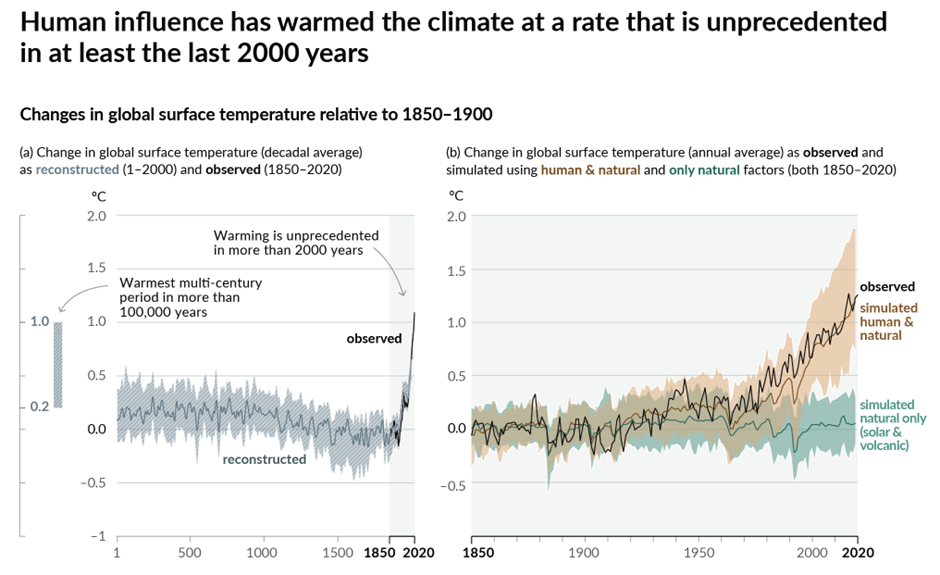
Figure 2.0
(Source: IPCC, 2021)
The global warming example is a classic example of the tragedy of the commons, as nearly all countries need to undergo industrialization to develop their economies. This process involves burning fossil fuels, which releases greenhouse gases into the atmosphere, leading to climate change. The problem is that each country is acting in its own best interest, without considering the impact of its actions on the global community.
Another notable environmentally related example is the tragic ‘Death of the Aral Sea’. The Aral Sea, once the fourth largest freshwater lake in the world with an area of 68,000 square kilometres, has shrunk to just 10% of its original size within half a century (Refer to Figure 3.0 and Figure 3.1) (Boddy, 2023).
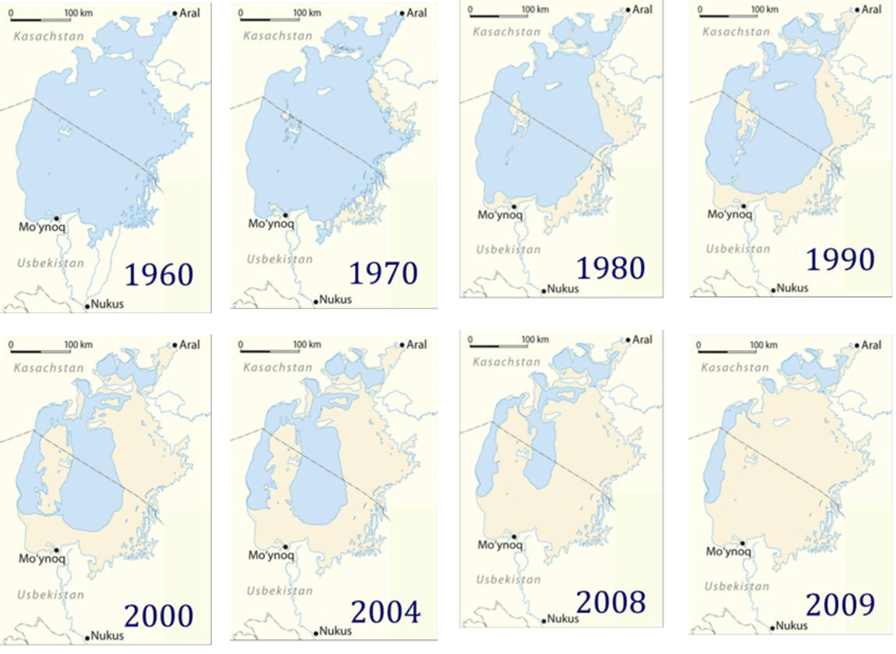
Figure 3.0: Desertification of the Aral Sea
(Source: Maksud Bekchanov, Nodir Djanibekov and Lamers, 2017)

Figure 3.1: Aral Sea in 2008 and 1989
(Source: Munteanu, 2015)
Once described as ‘one of the planet's worst environmental disasters’ by former United Nations Secretary-General, Ban Ki-Moon (UN News, 2010), the Aral Sea began to shrink in the 1960s. The Soviet Union constructed numerous irrigation canals from two feeder rivers of the Aral Sea, Syr Darya and Amu Darya as the Soviet Union attempted to boost cotton production for exports in the neighbouring Uzbek SSR (Grabish, 1999). The outcome? Soviet Russia soon dominated 25% of the world's cotton supply.
Beneath the glittering export figures, however, a problem soon emerged: the water level of the Aral Sea was dropping rapidly, and Soviet scientists knew that the Aral Sea would soon be gone. Time is of the essence, and they require a speedy resolution. Soon, the scientists came out with one of the most shameless solutions in history - by condemning the Aral Sea as “nature’s mistake,” a body of water that had no business existing, or commented that the Aral should “die beautifully.” (Hanks, 2021).
As expected, the Aral Sea soon ‘dies’. The entire ecosystem collapsed, with over 1,100 species of fish and aquatic plants becoming extinct; the fishing industry which 40,000 locals relied on obliterated; toxic, carcinogenic dust storms (by previous Soviet weapon tests, and runoff of pesticides) unleashed; and the once-thriving Aral Sea ultimately transformed into a barren, lifeless desert (Britannica, 2019).
The Aral Sea tragedy is a cautionary tale of the tragedy of the commons. When individuals act in their self-interest without considering the impact of their actions on the common good, the results can be devastating.
Thirdly, the tragedy of the commons can be applied to the public health arena. One major public health issue is antimicrobial resistance (AMR). AMR occurs when microorganisms survive exposure to antimicrobial medicines, such as antibiotics. This means that the drugs are no longer effective in treating infections. Infections that were once easily treatable can now become fatal. (Imperial College London, n.d.).
Every year in the United States, at least two million people become infected with bacteria that are resistant to antibiotics and at least 23,000 people die each year as a direct result of these infections (Esguerra, 2017). To address the AMR issue, the World Health Organisation (WHO) published a study of global priority pathogens (GPP) (as shown in Figure 3.0), urging for a global unitary effort to develop new antibiotics to combat these enhanced pathogens (WHO, 2019).
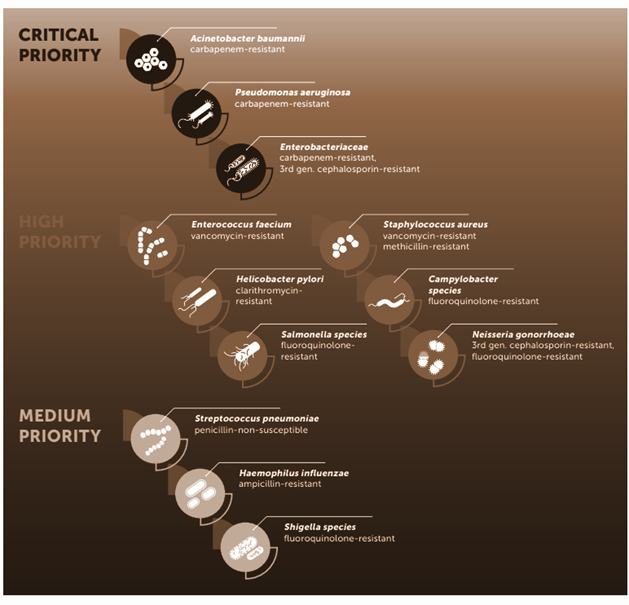
Figure 4.0
(Source: WHO, 2019)
The bacterial resistance that Enterobacteriaceae family bacteria (which contains the infamous E.coli bacteria) gained is truly alarming. Both carbapenem and cephalosporin were widely regarded as a drug of last resort (DOLR) and among the ‘strongest’ antibiotics (Verywell Health, n.d.). By 2023, the WHO had warned the public that they were running out of suitable antibiotics to treat ‘superbugs’ like the Carbapenem-resistant Enterobacteriaceae (Hopkins, 2023).
One of the core factors that led to our concurrently precarious situation is the misuse of antibiotics. In the US, an estimated 20% to 50% of all antibiotics prescribed in hospitals are either unnecessary or inappropriate (Ha, Haste and Gluckstein, 2017). Meanwhile, in China, as much as 48.4 million kilograms of antibiotics were consumed in the swine industry in 2013, including last-resort antibiotics like colistin (Yang et al., 2019). The misuse of such antibiotics proves disastrous, as recent research shows multidrug resistance in 91% of isolated samples of E. coli strains tested all across China. Among them, are strains that are resistant to last-resort drugs including colistin, carbapenems and tigecycline. (Peng et al., 2022)
The misuse of antibiotics is a classic example of the tragedy of the commons. When individuals use antibiotics unnecessarily or inappropriately, they are not taking into account the fact that they are contributing to the development of antimicrobial resistance, which can have negative consequences for everyone.
4.0 Conclusion
The tragedy of the commons encapsulates the delicate balance between individual interests and communal well-being in managing shared resources. From environmental degradation to public health crises, its pervasive influence underscores the pressing need for multifaceted solutions. Regulation, cooperation, and awareness emerge as vital tools in mitigating this tragedy, urging societies to navigate toward sustainable practices. By acknowledging the complexities and employing collaborative efforts, we pave the way for responsible resource management, safeguarding these shared assets for the benefit of present and future generations.
Article by Woo Shinyi, Tu Yizhi and Chua Yu Heng
References:
Alexandra, S. (2019, February 6). Tragedy of the commons: Examples & solutions: HBS Online. Business Insights Blog. Available at: https://online.hbs.edu/blog/post/tragedy-of-the-commons-impact-on-sustainability-issues#:~:text=The%20tragedy%20of%20the%20commons%20refers%20to%20a%20situation%20in,British%20writer%20William%20Forster%20Lloyd. (Accessed: 3rd December 2023)
Bansard, J. and Schröder, M. (2021). The Sustainable Use of Natural Resources: The Governance Challenge. [online] International Institute for Sustainable Development. Available at: https://www.iisd.org/articles/deep-dive/sustainable-use-natural-resources-governance-challenge [Accessed 10 Dec. 2023].
Britannica (2019). Aral Sea - Environmental Consequences. In: Encyclopædia Britannica. [online] Available at: https://www.britannica.com/place/Aral-Sea/Environmental-consequences.
Esguerra, E.M. (2017). Super Bugs and Antimicrobial Stewardship. Missouri Medicine, [online] 114(6), pp.438–439. Available at: https://www.ncbi.nlm.nih.gov/pmc/articles/PMC6139960/.
Grabish, B. (1999). Dry Tears of the Aral. [online] United Nations. Available at: https://www.un.org/en/chronicle/article/dry-tears-aral.
Ha, D.R., Haste, N.M. and Gluckstein, D.P. (2017). The Role of Antibiotic Stewardship in Promoting Appropriate Antibiotic Use. American Journal of Lifestyle Medicine, 13(4), pp.376–383. doi:https://doi.org/10.1177/1559827617700824.
Hanks, R.R. (2021). ‘Louder than Words’: A Profile of the Destruction of the Aral Sea and Its Consequences. [online] Association for Asian Studies. Available at: https://www.asianstudies.org/publications/eaa/archives/louder-than-words-a-profile-of-the-destruction-of-the-aral-sea-and-its-consequences/.
Hardin, G. (1968). The Tragedy of the Commons. Science, 162(3859), pp.1243–1248. doi:https://doi.org/10.1126/science.162.3859.1243.
Hopkins, C. (2023). As Superbug Infections Grow More common, the World Is Running out of Drugs to Treat Them. [online] NBC News. Available at: https://www.nbcnews.com/health/health-news/-arrived-post-antibiotic-era-warns-new-drugs-deadly-superbugs-rcna76601.
Imperial College London. (n.d.). What is antimicrobial resistance? [online] Available at: https://www.imperial.ac.uk/arc/about-us/what-is-amr/.
IPCC (2021). Climate Change 2021 Working Group I contribution to the Sixth Assessment Report of the Intergovernmental Panel on Climate Change. [online] IPCC. Available at: https://www.ipcc.ch/report/ar6/wg1/downloads/report/IPCC_AR6_WGI_SPM.pdf.
Jane, S. and Cox, B. (n.d.). DISCUSSION PAPERS No Tragedy on the Commons. [online] Available at: https://dlc.dlib.indiana.edu/dlc/bitstream/handle/10535/3113/buck-NoTragedy.pdf?sequence=1&isAllowed=y.
Maksud Bekchanov, Nodir Djanibekov and Lamers, J. (2017). Water in Central Asia. Routledge eBooks. doi:https://doi.org/10.9774/gleaf.9781315679396_11.
Mathew, P., Sivaraman, S. and Chandy, S. (2019). Communication strategies for improving public awareness on appropriate antibiotic use: Bridging a vital gap for action on antibiotic resistance. Journal of Family Medicine and Primary Care, [online] 8(6), p.1867. doi:https://doi.org/10.4103/jfmpc.jfmpc_263_19.
Matto, M. (2019, April 23). The tragedy of the tragedy of the Commons. Scientific American Blog Network. https://blogs.scientificamerican.com/voices/the-tragedy-of-the-tragedy-of-the-commons/ (Accessed: 3rd December 2023)
Media Inc, F. S. (2016, January 18). An introduction to the tragedy of the Commons. Farnam Street. Available at: https://fs.blog/the-tragedy-of-the-commons/ (Accessed at: 3rd December 2023)
Nina Munteanu (2015). What Was Once The Aral Sea. [online] The Meaning of Water. Available at: https://themeaningofwater.com/2015/08/06/what-was-once-the-aral-sea/ [Accessed 4 Dec. 2023].
OWEN, M. (2021, August 20). What is the tragedy of the commons?. Earth.Org. Available at: https://earth.org/data_visualization/what-is-the-tragedy-of-the-commons/ (Accessed: 3rd December 2023)
Peng, Z., Hu, Z., Li, Z., Zhang, X., Jia, C., Li, T., Dai, M., Tan, C., Xu, Z., Wu, B., Chen, H. and Wang, X. (2022). Antimicrobial resistance and population genomics of multidrug-resistant Escherichia coli in pig farms in mainland China. Nature Communications, [online] 13(1), p.1116. doi:https://doi.org/10.1038/s41467-022-28750-6.
Picano, E., Mangia, C. and D’Andrea, A. (2022). Climate Change, Carbon Dioxide Emissions, and Medical Imaging Contribution. Journal of Clinical Medicine, 12(1), p.215. doi:https://doi.org/10.3390/jcm12010215.
THE INVESTOPEDIA TEAM (2023). What Is the Tragedy of the Commons in Economics? [online] Investopedia. Available at: https://www.investopedia.com/terms/t/tragedy-of-the-commons.asp#:~:text=Supply%20and%20Demand- [Accessed 10 Dec. 2023].
Tim Boddy (2023). Picturing life in the dust bowl remains of the once mighty Aral Sea. [online] New Scientist. Available at: https://www.newscientist.com/article/mg26034670-200-picturing-life-in-the-dust-bowl-remains-of-the-once-mighty-aral-sea/ [Accessed 4 Dec. 2023].
UN News. (2010). Shrinking Aral Sea underscores need for urgent action on environment – Ban. [online] Available at: https://news.un.org/en/story/2010/04/334402.
Verywell Health. (n.d.). What You Need to Know About Superbugs. [online] Available at: https://www.verywellhealth.com/what-is-a-superbug-1958843.
WHO (2019). Prioritization of pathogens to guide discovery, research and development of new antibiotics for drug-resistant bacterial infections, including tuberculosis. World Health Organization.
Yang, H., Paruch, L., Chen, X., van Eerde, A., Skomedal, H., Wang, Y., Liu, D. and Liu Clarke, J. (2019). Antibiotic Application and Resistance in Swine Production in China: Current Situation and Future Perspectives. Frontiers in Veterinary Science, [online] 6. doi:https://doi.org/10.3389/fvets.2019.00136.

Comments